

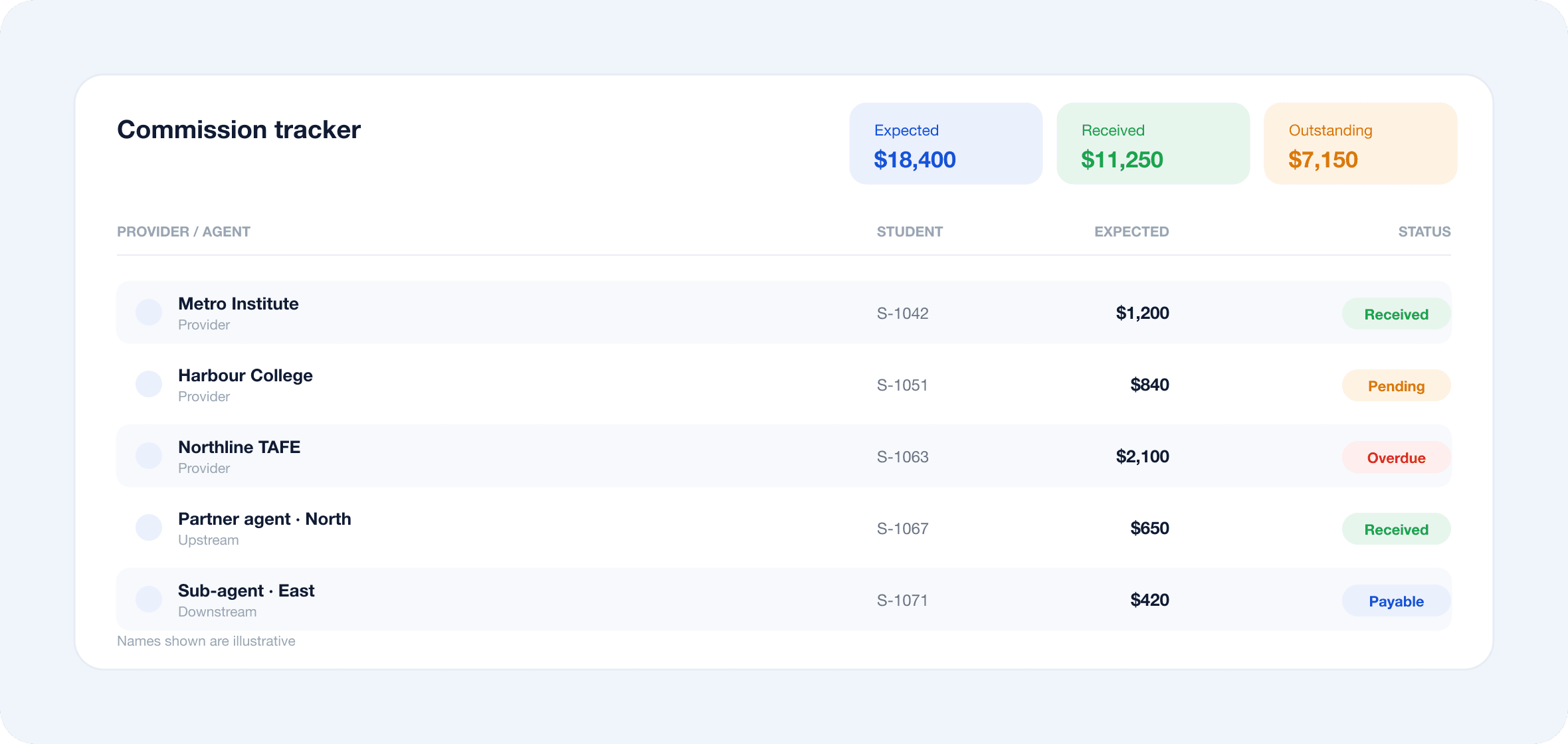
In short
Education agent commission is unusual among receivables: you invoice nobody, the rate is set by a schedule you did not write, and payment often arrives months later bundled across several students on one remittance. Spreadsheets fail at this because they collapse expected, confirmed and received into a single number — so the most common symptom is not a dramatic error but a commission nobody chased, because nobody noticed it had not arrived.
Education agent commission tracking is unusual among receivables. You invoice nobody, the amount depends on a schedule you did not write, and the payment can arrive months after the work, bundled with several other students on a single remittance.
Spreadsheets cope with this until they do not, and the failure is rarely dramatic. It is a commission that was never chased, because nobody noticed it had not arrived.
Why does commission tracking break in spreadsheets?
- Rates differ by provider, by course and sometimes by intake, so one formula does not cover the sheet
- A remittance covers several students at once, so matching payments to placements is manual
- Sub-agent shares are calculated from a figure that may itself still be an estimate
- Nothing distinguishes expected from confirmed from received, so the total mixes all three
- Deferrals and withdrawals change entitlement after the row was written
Track the stage, not just the amount
The change that helps most is separating the lifecycle of a commission from its value. A student placement moves through applied, offered, accepted, enrolled and paid. Each stage changes what you are entitled to and how confident you can be in it. A single commission column collapses all of that into one number and discards the information you actually need to act.
Match at the placement, not the remittance
If each expected commission is attached to the student and course that generated it, a bundled remittance becomes a reconciliation against known lines rather than a puzzle. Anything unmatched at the end is either a payment you were not expecting or an entitlement you have not been paid — and both are worth knowing about immediately.
Calculate sub-agent shares from what arrived
Paying a sub-agent from an estimate means correcting it later, which is awkward with people you want to keep working with. Deriving the share from the amount actually received removes the correction entirely, and makes the partner relationship easier to run.
Casewise tracks education commission from the application through to the payment, against the placement that earned it, with sub-agent shares derived from the received amount. Our education agent software shows how that fits alongside student, provider and course management.
Frequently asked questions
How do education agents track commission?
The reliable approach is to attach each expected commission to the specific student placement that generated it, and to track the stage of that placement separately from its value. A placement moves through applied, offered, accepted, enrolled and paid, and each stage changes both what you are entitled to and how confident you can be in the figure.
Why does commission tracking fail in spreadsheets?
Five reasons recur: rates differ by provider, course and sometimes intake so one formula does not cover the sheet; a single remittance covers several students so matching is manual; sub-agent shares are calculated from figures that may still be estimates; nothing distinguishes expected from confirmed from received; and deferrals or withdrawals change entitlement after the row was written.
How should sub-agent commission shares be calculated?
From the amount actually received, not from the expected figure. Paying a sub-agent against an estimate means correcting it later, which is awkward with partners you want to keep working with. Deriving the share from the received payment removes the correction entirely.
What is commission reconciliation for education agents?
It is matching a provider's remittance — which typically covers multiple students at once — against the individual placements you expected to be paid for. If each expected commission is already attached to its placement, reconciliation becomes a check against known lines, and anything left unmatched is either an unexpected payment or an entitlement you have not been paid.

