

In short
Australian migration agents lose most of their administrative time to four things: chasing documents by email, re-typing the same identity data into multiple systems, having no single view of which matters have stalled, and rebuilding document checklists from memory for each subclass. All four are process problems rather than workload problems, and all four can be reduced without adding staff.
Ask a registered migration agent where their week goes and very few will say casework. The legal thinking on a matter — assessing eligibility, choosing a subclass, framing a submission — is the part of the job that actually requires a registered agent. It is rarely the part that fills the calendar.
What fills the calendar is the administration wrapped around that thinking. Visa case management, in the day-to-day sense, is mostly chasing, filing and re-typing. It is worth being specific about where that time goes, because the fix is different at each stage.
Where does migration agent admin time actually go?
Across the Australian agencies we built Casewise with, the same four drains came up in nearly every conversation. They are listed here in rough order of cost.
1. Chasing documents by email
Almost every practice describes the same loop. You send a document checklist by email. Some documents come back, usually as phone photos attached to a reply that also contains three questions. You file what arrived, work out what did not, and send a follow-up. A week later you send another.
The cost is not the individual email. It is holding the state of every open matter in your head — who owes what, who was chased when, and which of the twelve attachments in a thread is the current payslip rather than the one it replaced.
- Documents arrive in the same channel as questions, so neither gets handled cleanly
- There is no single view of what is outstanding across all active visa matters
- Superseded versions sit alongside current ones with nothing marking the difference
- Follow-ups depend on someone remembering to send them
2. Re-typing the same identity data
A passport number is typed into the client record, then into a form, then into a lodgement, then into a spreadsheet someone keeps for reporting. Each retype is a chance to introduce an error, and errors in identity data are expensive to find later because everything downstream still looks plausible.
3. Not knowing which matters have stalled
Most practices can tell you what is urgent this week. Far fewer can tell you, without going looking, which matters have not moved in a fortnight. Those are the ones that become problems — not because anyone decided to deprioritise them, but because nothing surfaced them.
Visa expiry dates, bridging visa conditions and lodgement windows all sit in this category. They are known, they are written down somewhere, and they are only as reliable as whoever remembers to look.
4. Rebuilding checklists from memory
The document set for a given subclass is knowable and largely stable, yet in many practices it is reconstructed each time from the last similar matter someone can find. That is slow, and it is how requirements get missed on the matters that are slightly unusual.
How do you actually reduce visa case admin?
The changes that win time back are unglamorous, and none of them require new software to begin:
- Separate document collection from correspondence, so a checklist has a state you can read at a glance rather than a thread you have to reconstruct
- Enter identity data once and reference it, rather than copying it into each new artefact
- Make the list of stalled matters something the system produces, not something a person remembers to compile
- Write down the standard document set per subclass once, and reuse it
Casewise was built around exactly these four, because they were the four that came up every time. If you would rather see it than read about it, our migration agent software walks through what each stage looks like in a real practice, and the pricing page sets out what it costs.
Frequently asked questions
What takes up the most time in visa case management?
Document collection. Most Australian migration agents report that chasing clients for documents by email consumes more time than any other administrative task, because each matter requires tracking what was requested, what arrived, what is superseded and who was followed up when — across every open file at once.
How can migration agents reduce visa case admin time?
Four changes help most: separate document collection from general correspondence so a checklist has a readable state, enter identity data once and reference it rather than re-typing it, make stalled matters something the system surfaces rather than something a person remembers to check, and write down the standard document set per visa subclass so checklists are not rebuilt from memory.
Do migration agents need dedicated case management software?
Not necessarily, but generic CRMs are a poor fit because they have no concept of a visa matter, dependants, document checklists by subclass, or lodgement deadlines. Practices running on spreadsheets and shared drives usually manage until caseload or headcount grows, at which point the lack of a single view becomes the constraint.
What is a visa matter in practice management software?
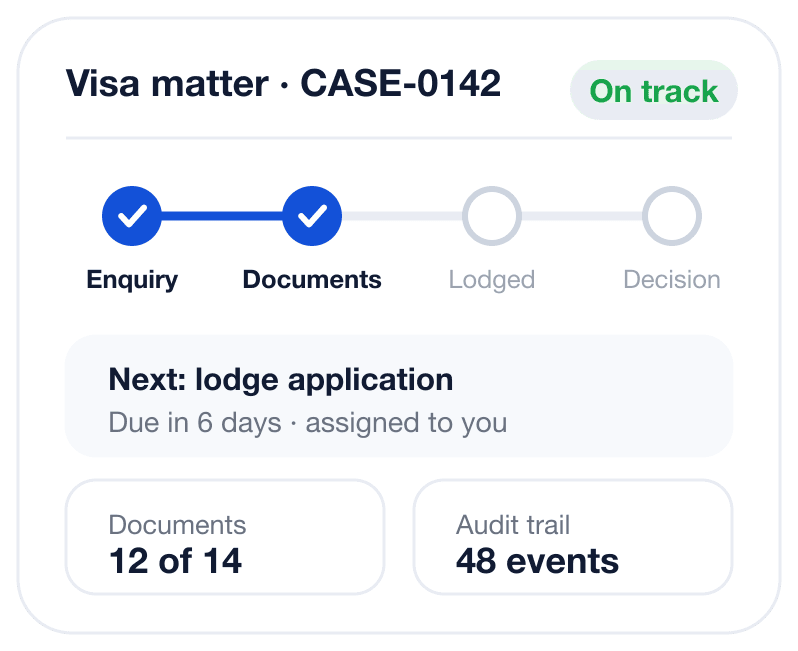
A visa matter is the record of one application: the subclass being pursued, the primary applicant and any dependants, the documents required and received, the agreement and fees, the tasks outstanding, and the history of what was advised and when. Keeping it as a single linked record is what makes the file possible to produce completely later.

